



Dating Antique Brooch Pins by Their Clasp: A Collector’s Guide
Experienced dealers turn a brooch over before they look at the front. The reason is practical rather than ceremonial. Fashion in stones and settings was revived and imitated constantly across the past two centuries, but fastening hardware followed the actual chronology of patents and manufacturing, which makes the mechanism on the back the most reliable dating evidence available. Anyone buying antique brooch pins can learn to read this in an afternoon, and it will prevent most of the mistakes that cost beginning collectors money.
The front tells you what a piece was meant to look like. The back tells you when it was made.
The C-Clasp and the Long Pin
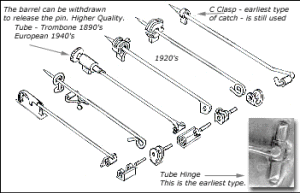
The earliest and simplest fitting is a plain C-shaped hook that the pin stem rests inside, with nothing holding it in place beyond friction and the tension of the stem itself.
C-clasps dominate the nineteenth century and remain common into the early twentieth. They are frequently paired with a pin stem that extends noticeably beyond the edge of the brooch body, sometimes by a centimeter or more. That extension is a strong indicator of an early piece, since it was designed to pass through the heavy fabrics of the period and provide grip.
A C-clasp with a long, extended stem points broadly to the Victorian era. A C-clasp with a stem that ends flush with the body generally indicates something later, since manufacturers shortened stems as fabrics lightened.
The Trombone Clasp
The trombone is European in origin and appears from roughly the 1890s through the 1920s and 1930s. It works by pulling a small cylindrical sleeve outward, sliding the pin into position, and pushing the sleeve back to lock it.
The mechanism is distinctive and unmistakable once seen. Its presence generally suggests continental European manufacture, which is useful contextual information alongside the date range. French and Austrian pieces carry it frequently.
The Safety Catch
The rotating safety catch, in which a small hinged lever swings over to enclose the pin stem, becomes widespread from around the 1910s onward and is standard by the 1920s.
Its presence establishes a rough earliest date. A brooch with an original rotating safety catch is unlikely to predate the early twentieth century. This is where the tool becomes genuinely powerful, because a piece styled to look Victorian but fitted with an original safety catch is not Victorian.
Later variants including locking mechanisms and modern spring catches indicate mid-century or contemporary manufacture.
Hinges, Joints, and Other Tells
The hinge holding the pin stem is equally informative. Early pieces typically use a simple tube hinge, meaning a small cylinder soldered directly to the back. Later manufacturing introduced ball hinges and more standardized components.
Look also at how the fittings attach. Hand-soldered joints on early pieces show slight irregularity and visible solder. Machine-applied findings sit uniformly and identically across every example of a design.
Check the back plate itself. Period pieces frequently show hand finishing, engraving, or openwork on surfaces no wearer would see.
When the Clasp Has Been Replaced
Repairs are common and are not a reason to walk away. Brooch fittings take stress and break, and a hundred-year-old piece may reasonably be on its second catch.
The evidence is usually visible. Look for solder color that differs from the surrounding metal, a catch that sits at a slightly different angle than the hinge, or hardware that appears newer than the rest of the back.
What matters is disclosure. A replaced catch on an otherwise authentic Victorian brooch is a repair. A modern catch on a piece being sold as period without mention is a problem. Ask directly, and note that a knowledgeable seller will point out replacements before you find them.
What the Front Confirms
Once the clasp has established a plausible window, the front should agree with it. Stone cutting is the best cross-check. Rose cuts and old mine cuts belong to earlier periods, old European cuts to the late nineteenth and early twentieth centuries, and modern brilliants to later work or replacement.
Metal, motif, and construction should all sit comfortably inside the same range. When the front and the back disagree, the back is usually right.
Why Brooches Remain a Collector’s Entry Point
Brooches consistently offer more craftsmanship per dollar than rings of comparable age and quality. Demand for period rings is driven by the engagement market, which brooches do not compete with, so pricing stays more reasonable.
For collectors, that means access to genuinely fine hand fabrication, unusual stones, and significant makers at a level that rings rarely permit.
Building a Collection
Learn the clasps first. Everything else follows more easily once you can place a piece within a rough window before considering anything else about it.
For collectors and gift buyers who want pieces with the dating and condition work already done, Gesner Estate Jewelry offers period brooches with documented detail. Visit the site to browse the current selection.