



Choosing a Medicine Cabinet That Actually Fits Your Bathroom
Most bathroom renovations treat storage as an afterthought, something to figure out after the tile and fixtures are already chosen. That’s usually a mistake. A medicine cabinet does double duty as both storage and mirror, and getting the size, depth, and mounting style wrong means living with a fixture that never quite works for the space it’s in.
The category sounds simple on the surface, a mirrored door over a shallow cabinet, but the differences between models add up quickly once installation starts. Interior depth determines whether it can hold anything taller than a travel-size bottle. Mounting type determines whether the wall needs to be cut into or can stay intact. Mirror quality determines whether the fixture still looks sharp five years in, or starts showing cloudy edges within the first year of humid use.
Recessed vs. Surface Mount
The first real decision in choosing a medicine cabinet is whether it sits recessed into the wall or mounts on the surface.
Recessed cabinets:
- Require cutting an opening between wall studs
- Add more labor during installation
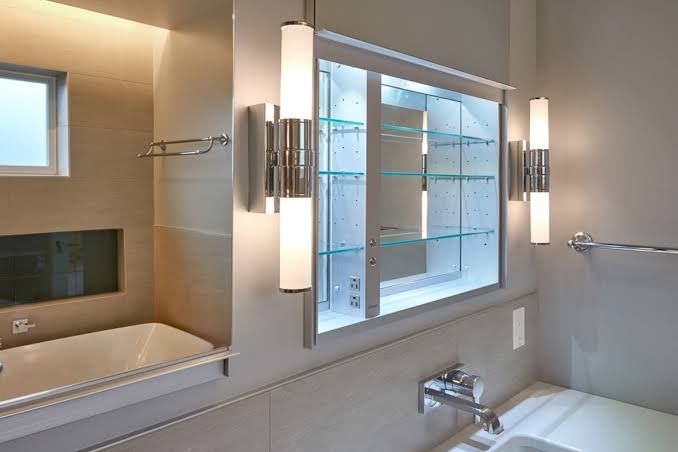
- Result in a flush, built-in look once finished
- Work best in new construction or a full gut renovation, where the wall cavity is already open and stud spacing can be planned around the cabinet’s width
Surface-mount cabinets:
- Attach directly to the finished wall with anchors, no wall cutting required
- Project a few inches further into the room than a recessed unit
- Matter most in a small bathroom where every inch of clearance counts
- Are far easier to retrofit into an existing bathroom without touching drywall or plumbing behind the wall
A smaller subset of mirror-style units now use no-drill mounting hardware, which avoids damaging tile or finished walls entirely. That option is worth checking for anyone who wants to swap the fixture later without leaving holes behind.
Depth, Shelving, and What Actually Fits Inside
Interior depth is where most buyers get surprised after the fact.
- Under 4 inches of interior clearance: struggles to hold standard prescription bottles standing upright, and rules out anything bulkier like a tall skincare pump or an electric toothbrush charging base
- Deeper cabinets: solve that storage problem but need more clearance from the wall, and can start to feel bulky in a tight powder room
- Adjustable shelving: lets a household reconfigure the interior as needs change, more shelf space for a family with kids, taller gaps for anyone who keeps larger bottles or grooming tools on hand
- Fixed shelving: forces everything into whatever height the manufacturer chose, with no way to adjust later
Door hardware matters just as much as the interior layout:
- Soft-close hinges keep the door from slamming shut in a small bathroom where every sound echoes off tile
- Magnetic door catches hold the door flush without a mechanical latch that can loosen or rattle over time
- Door swing direction is worth checking against nearby fixtures, a door that swings into a shower door or vanity drawer is a daily annoyance that’s easy to avoid by checking the layout before ordering
Mirror Quality and Added Features
Not every medicine cabinet is built the same behind the glass. Lower-quality mirrors can develop cloudy edges or dark spots within a year or two in a humid bathroom, especially without adequate ventilation. Higher-end units use backing designed to resist that moisture exposure, which extends the usable life of the mirror well beyond the cabinet’s structural hardware.
Some cabinets now integrate lighting directly into the mirror or frame, combining task lighting with storage in a single fixture. Features to compare across lit models include:
- Adjustable color temperature, often somewhere between 3000K and 6000K, letting the same fixture run warmer for evening routines and cooler for detailed grooming during the day
- CRI (color rendering index), which affects how accurately skin tones and fabric colors appear under the light; ratings below 80 tend to distort colors noticeably, which is part of why higher-end lit cabinets aim for 90 or above
- Anti-fog functionality, typically a low-wattage heating element behind the glass that keeps the surface clear during and after a shower, useful mainly in bathrooms with limited exhaust ventilation
- Built-in electrical outlets, some rated for as much as 1800 watts, letting a hair dryer or straightener run directly from the cabinet interior instead of a separate wall outlet
- USB-A or USB-C charging ports, useful for anyone who keeps a toothbrush or trimmer charging near the sink
Certification, Installation, and What to Check Before Ordering
Any cabinet with built-in electrical components should carry ETL or UL certification, confirming the wiring has been tested against a recognized safety standard rather than relying on the manufacturer’s own claims. This matters more than it might seem, since these units draw line voltage directly rather than running on a battery.
A quick pre-order checklist worth running through:
- Confirm mounting type (recessed, surface, or no-drill) against the existing wall and tile
- Measure available wall width and height, including clearance for door swing
- Check interior depth against what actually needs to fit inside
- Verify ETL/UL certification if the unit has lighting or an outlet
- Confirm shipping timeline and return window before checkout
Installation timelines vary significantly based on mounting type. Recessed installation generally requires a licensed electrician or contractor if it involves cutting into a wall with existing wiring nearby, while surface mount and no-drill options are realistic DIY projects for someone comfortable with basic tools. Retailers focused specifically on bathroom fixtures, such as Allsumhome, typically list interior depth, mounting type, and certification directly on the product page, which shortens the comparison process considerably compared to sorting through spec sheets from multiple vendors.
Shipping and returns are worth confirming before ordering as well. Free shipping within the contiguous United States has become close to standard among fixture retailers, but return windows and restocking terms still vary enough that it’s worth checking before checkout, particularly for a fixture that needs to fit an exact wall opening.
Choosing a medicine cabinet ultimately comes down to matching the fixture to the bathroom rather than picking whatever looks best in a photo. Measuring available wall width and height, including clearance for the door swing, narrows the field before finish or feature comparisons even start. From there, depth, mounting type, and mirror quality determine whether the cabinet still works well five years after installation, not just on the day it goes up.