


In the ever-evolving world of bridal fashion, 2026 has marked a definitive shift toward “Modern Heritage”—a design philosophy that prioritizes architectural integrity and historical narrative over mass-produced uniformity. At the heart of this movement is the resurgence of the art deco engagement ring, a style that continues to captivate modern couples with its bold geometric precision and unapologetic glamour. Born in the “Roaring Twenties,” this aesthetic was a radical departure from the flowing, organic lines of the past, embracing instead the streamlined symmetry of the machine age. Today, these pieces are prized not just for their striking visual impact, but for their ability to blend a century of history with a forward-thinking sense of individual style.
The Architectural Blueprint of the 1920s
The Art Deco era (circa 1920–1935) was defined by a global hunger for modernization. Inspired by the soaring silhouettes of skyscrapers like the Chrysler Building and the precision of industrial engineering, jewelry designers began to treat the engagement ring as a structural masterpiece.
Unlike contemporary designs that often favor a simple, raised center stone, Art Deco rings utilize the entire setting to tell a story. The use of “white-on-white” palettes—achieved through the mastery of platinum and the newly introduced white gold—created a cool, sophisticated backdrop. This allowed the focus to remain on the interplay of light and shadow created by the ring’s mathematical balance, making it a favorite for those who view jewelry as wearable art.
Signature Hallmarks of Deco Design
To understand why these rings remain so sought-after by antique collectors and luxury gift buyers alike, one must look at the specific artisanal techniques that define the period:
- Geometric Precision: Art Deco design is synonymous with clean lines and repeating patterns. You will often find triangles, squares, and chevrons integrated into the metalwork, creating a sense of order and purpose.
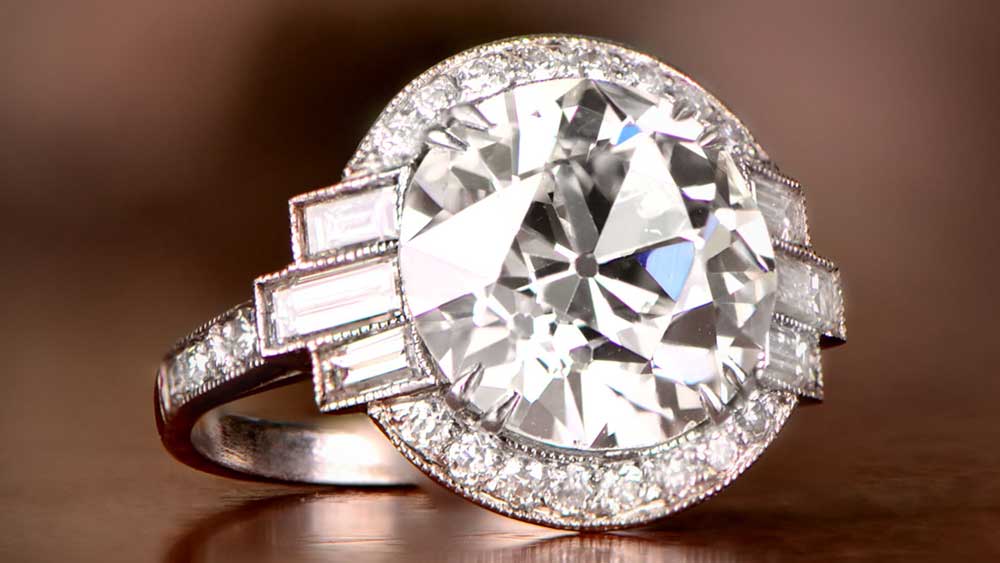
- Step-Cut Diamonds: The era popularized “step-cuts” such as the Emerald and Asscher cuts. These stones feature long, linear facets that emphasize clarity over the simple brilliance of modern rounds, offering a sophisticated “hall of mirrors” effect.
- Calibre-Cut Accents: A hallmark of high-end Deco jewelry is the use of calibre-cut gemstones. These are small stones—often sapphires, rubies, or emeralds—that have been custom-cut to fit perfectly into a geometric setting with no gaps, creating a mosaic of vibrant color.
- Intricate Milgrain: To soften the bold industrial lines, jewelers utilized milgrain—tiny, beaded metal borders along the edges of the setting. This adds a delicate, lace-like texture that is incredibly difficult to replicate with modern manufacturing methods.
The Rise of the “Conscious Collector” in 2026
One of the primary drivers of the Art Deco boom in 2026 is the global focus on sustainability and ethical luxury. For the modern bride, choosing a genuine antique engagement ring is a powerful way to reduce the environmental impact of their union. By opting for a piece that already exists, couples bypass the environmental toll of modern mining, making their choice as ethical as it is elegant.
Furthermore, the longevity of these pieces is a testament to the quality of early 20th-century craftsmanship. Many Art Deco rings were “die-struck,” a process that compresses the metal into dense, durable forms that have survived a hundred years of wear. Choosing an estate ring means investing in a piece that has already proven its durability, destined to become a multi-generational heirloom.
Styling the Deco Look Today
In 2026, the trend is toward “Curated Stacks.” Brides are increasingly pairing their geometric engagement rings with modern bezel-set bands or chunky gold “Gypsy” rings. The versatility of the Art Deco aesthetic allows it to play well with both contemporary minimalism and maximalist layers.
Because many Deco rings feature a lower profile than modern “Tiffany-style” settings, they are also favored by those with active lifestyles. They offer a secure, snag-free design that feels substantial on the hand without being cumbersome. Whether set in platinum to highlight a diamond’s colorless fire or in yellow gold for a warm, “Old Money” glow, these rings remain the ultimate identifier of personal taste.
Finding Your Piece of History
Navigating the world of fine antiques requires more than just an eye for beauty; it requires an understanding of provenance, hallmark dating, and the unique facets of antique-cut stones like the Old European or Transitional cut. Authenticity is the cornerstone of value in the estate market, and working with a specialist ensures that your investment is as genuine as your commitment. For those ready to move beyond the ordinary, Gesner Estate Jewelry serves as a professional gateway to the finest authentic treasures, providing the expertise needed to help you find an engagement ring that resonates with timeless elegance and historical significance.